
If It Doesn’t Suck, It Doesn’t Count: How AI Exposes Our Broken Idea of Rigor

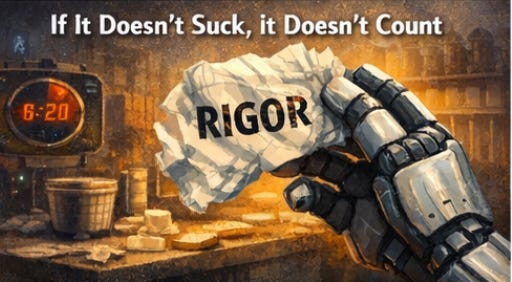
There’s a lie that’s been sitting in the middle of education for so long we hardly notice it anymore:
If it isn’t hard, if it doesn’t suck, it doesn’t count.
We don’t say it that bluntly in mission statements or policy manuals.
But we live it.
If kids aren’t miserable, we assume they’re not really learning.
If teachers aren’t exhausted, we assume they’re not really working.
If a process is faster and smoother, we assume it must be “cheating.”
And then along comes AI.
Suddenly we’re holding a tool that can multiply our thinking, organize our chaos, and accelerate our learning—and a lot of people’s first instinct is guilt, suspicion, or panic.
To untangle that, I need to take you back to three things:
a legendary Arizona football coach named Paul Moro,
a field full of plows and tractors, and
a tiny little microphone button that changed my life.
Coach Paul Moro, “Sonny,” and the Right Question
Coach Paul Moro was my high school coach and later my mentor. If you know Arizona high school football, you know the name. State titles. Legacy. Standard-bearer.
Back then, he called me “Sonny.” That was my childhood nickname—the name I carried through growing up, through ball, through those early identity-forming years. Later, after college, I made a deliberate choice to change my name as a personal rite of passage—my way of saying, I’m standing as an adult now. There’s a whole story in that, which I’ll unpack another time.
For this moment, just know this: when Coach Moro called me “Sonny,” he was speaking to that younger version of me—the kid who was still learning who he was and why he did what he did.
Years later, when I started coaching, I sat down with him to “pick his brain.” He rolled the film, and I did what every young coach does when they’re trying to level up fast: I peppered him with questions.
For an hour and a half I asked him:
“How do you teach this?”
“How do you drill that?”
“How do you call this coverage?”
“How do you build this package?”
Finally, he paused the tape, turned, and said:
“Sonny, when are you going to ask me the right question?”
I was confused.
“What do you mean? I’ve been asking questions for an hour and a half.”
He said:
“You keep asking me how I do what I do.
You haven’t asked me once why I do what I do.
That’s the most important thing.
There are a thousand hows.
If you don’t know your why, you’re going to be frustrated.
You’ll try a lot of things and you won’t know why.
You’ll be lost.
But once you anchor into your why, that clarifies your purpose and what you’re trying to do.”
That conversation was my first real collision with intentionality.
From then on, I became the “why guy.”
In coaching. In classrooms. In leadership meetings. With principals, I’d ask:
“Why did you take this job? Why do you do what you do?”
You’d be amazed how often the room goes quiet.
Most of us are very busy with how.
Very few of us slow down long enough to ask why.
Championship Thinking: Learn as Much as You Can as Fast as You Can
Fast-forward to the pandemic era.
I came back to the classroom and picked up an AP class in October because the original teacher left due to COVID. I walked into an IB environment I’d never worked in before—these were high-octane kids. Little college students in high school. Sharp, driven, self-motivated.
On day one, I gave them a simple mantra:
“Our job here is to learn as much as we can as fast as we can.”
That’s it. That’s my 21st-century learning mantra.
Not:
“Suffer as much as you can as long as you can.”
“Prove your worth by how miserable you are.”
Just:
Learn as much as you can, as fast as you can—
for a why that actually matters to you.
That’s championship thinking, another gift from Coach Moro.
Championship thinking knows:
There’s a dream out ahead of a bunch of goals.
The dream is never guaranteed.
The goals are—if you guarantee your actions.
Back when we started the Shadow Ridge wrestling program, I used to tell the kids:
“Goals are the fuel for your dreams.
Dreams are what drive you.”
But none of that gets off the ground if you don’t know your why.
Plows, Tractors, and a Field That Plows Itself
Let’s switch fields—from football to farming.
Teaching, at its core, is plowing ground.
We’re trying to break up hard, compacted soil so something living can take root.
The soil is the student’s mind.
The plow is our instruction.
The fruit is actual learning and growth.
For most of history, plowing has been miserable work. Blisters. Sweat. Slow progress. “If it doesn’t suck, it doesn’t count” made a certain kind of sense when the only way to break ground was a steel blade and a sore back.
But look at how real farmers think about tools:
hand plow →
horse-drawn plow →
tractor →
GPS tractor →
robotic tractors that can plow straighter, longer, and more efficiently than any human ever could.
Now imagine a farmer standing in front of a self-driving tractor saying:
“No thanks. I need to get my ass out there with a hand plow so that it counts.”
We’d call that insane.
Farmers don’t worship the process of plowing.
They care about the fruit.
So here’s the question:
If a field could literally plow itself, would you let it?
Because that’s what AI offers.
AI is a self-plowing field for our minds:
It can break up intellectual ground.
It can organize information into rows.
It can plant the seeds we choose.
And it can even suggest new crops—ideas, connections, perspectives we never would’ve planted on our own.
The job of the teacher and learner shifts from:
“Be the motor. Feel the pain. Prove your worth by how hard you’re working.”
to:
“Choose the crop. Set the direction. Curate the seeds. Protect the field.
Harvest the fruit.”
The question is no longer,
“Is it hard enough to be real?”
The question becomes,
“Does it grow fruit?”
Dweck, Failure, and the Letter-Grade Bubble
This doesn’t mean struggle disappears.
Carol Dweck’s work on growth mindset is still dead-on:
Struggle matters.
Effort matters.
Challenge matters.
But she also makes a crucial point:
Struggle doesn’t have to suck.
You can reframe failure as learning instead of humiliation.
School, the way we built it, turned failure into a sport.
We invented letter grades.
We created a bubble called “school reality” where:
You get stamped A–F.
Your identity gets wired to those symbols.
Your “success” is measured by how well you play the game inside the bubble.
Where else in life do you get a letter grade for your existence?
Outside of school:
You get feedback.
You adapt or you don’t.
You get consequences and opportunities, not a permanent “C+ in adulthood.”
Inside the system, we confuse:
Pain with rigor.
Suffering with seriousness.
We say we’re “preparing kids for the real world,” but we keep them in a simulation that looks nothing like reality while ignoring the tools reality is actually using.
AI doesn’t erase the need for effort.
It exposes how much pointless effort we’ve built into the system.
The Microphone Button and the Grocery Store Floor
When GPT first came out, I used it a lot.
But my life changed the day I discovered the little microphone button.
Tapping that button and going full stream of consciousness turned AI from “useful tool” into “essential partner.”
Instead of fighting my ADHD, my speed, my racing thoughts, I could:
talk freely,
dump everything—messy, emotional, half-formed—
and let the model handle the organization.
The best way I’ve found to describe it is with a grocery store metaphor.
Imagine you run a grocery store.
Old way:
A truck arrives.
Workers unload boxes.
They open, sort, and hand-place every item on every shelf.
Hours of labor just to get ready to open
New way:
The truck shows up.
You dump all the groceries in one giant pile in the middle of the floor. Total chaos.
You push one button, walk away, and when you come back:
every shelf is perfectly stocked,
every product is in the right place,
everything is categorized and ready.
No sane store owner would say:
“No, no, I prefer doing this the slow, painful way so it feels legitimate.”
But that’s exactly what we do with our minds.
The microphone lets me dump all the groceries—ideas, worries, stories, metaphors, fragments—right onto the mental floor. AI is the night crew that quietly:
stocks the shelves,
builds the aisles,
and gives it all back to me in order.
That’s not cheating.
That’s stewardship.
Intention → Attention: The Start of ICI
Here’s where this all meets my work with students around Intentional Cognitive Integration (ICI).
There’s a simple model I keep coming back to:
Intention leads to attention.
If you don’t set an intention, your attention is up for grabs.
If you don’t know your why, every notification, distraction, or anxiety can hijack you.
That’s why, when I introduce ICI in class, the ritual starts with a full stop:
Close the extra tabs.
Put the phone away.
Breathe.
Quiet the noise.
Then we ask:
Why am I doing this task?
Why am I opening AI?
What do I actually want to get out of this?
Only after intention is set do we invite AI into the conversation.
At that point, AI isn’t a cheat code.
It’s a tractor hitched to a clear destination.
Thinking in Metaphors: The Brain’s Native Language
One more piece of this: metaphors.
We underestimate how powerful metaphors are for learning and thinking. They’re not just decorative language. They’re neural super-tools.
A good metaphor:
taps into visual memory,
creates more associations,
digs deeper into the brain,
and makes abstract ideas stick.
Shawn Achor understood this when he used The Orange Frog as the metaphor for The Happiness Advantage. The frog is the hook; the happiness concepts hang on it.
In school, we quietly train kids away from that strength:
In K–3, we live in picture books.
Then we hit the cutoff: “No more picture books. Just words now, you’re big.”
Before third grade, you’re learning to read.
From fourth grade on, you’re reading to learn.
If you don’t get there by third grade, the system has very few ways to rescue you. We still push the content, still raise the difficulty, still worship “rigor,” but the foundation isn’t solid.
Metaphors—plows, tractors, grocery stores, frogs—let us reconnect to the brain’s natural way of learning: story + image + emotion.
AI supercharges that by helping us:
test metaphors,
refine them,
generate new ones,
and anchor concepts in language and imagery that fit the learner.
Democratizing Knowledge: Paulo Freire, Meet the Microphone
Paulo Freire dreamed of a democratized education—breaking the “banking model” where teachers deposit knowledge into passive students.
He didn’t have AI.
We do.
With intentional AI use, a student can:
ask one question and get what used to require a $2,000 course,
tailor explanations to their level and interest,
connect neuroscience, psychology, history, and their own lived experience in one conversation.
The bottleneck is no longer access to information.
The bottleneck is:
Do you know your why?
Can you set an intention?
Will you use the tool with integrity?
We can now give the average teenager access to what Paulo Freire dreamed about—if we’re willing to drop the lie that it “doesn’t count” unless it hurts.
Guaranteed Return: Show Up, Dump, Ask Why
If you’ve read this far, here’s the practical invitation.
Think of this like mixed martial arts training.
Imagine I tell you:
“If you just show up at this gym,
listen to what the coaches tell you,
and do the reps,
I guarantee you’ll become a better fighter.”
You don’t have to design the perfect workout.
You don’t have to reinvent the wheel.
You just have to show up and engage.
Intentional AI is like that.
You lose nothing by:
hitting the mic,
free-associating your thoughts,
dumping your fears, hopes, stories, questions.
You gain treasure if you’re willing to ask one simple question:
“Why am I doing this?”
Why am I dumping all this into AI?
Why do I want to understand my brain, my patterns, my story?
Why am I trying to learn as much as I can as fast as I can?
That’s the entry point.
Intentionality starts with why.
Why shapes your intention.
Intention directs your attention.
Attention guides how you use AI.
And once that cycle gets going, you don’t just plow more ground.
You grow better fruit
If this resonates…
If this hit something in you—especially if you’re a teacher, leader, parent, or student trying to figure out how to use AI without losing your soul—stick around.
This Substack is where I’m building out:
Intentional Cognitive Integration (ICI) – a framework for using AI to amplify, not replace, human purpose.
Real classroom experiments from the front lines.
The deeper neuroscience behind attention, motivation, and learning.
Stories from coaches, classrooms, and life on the edge of change.
Hit subscribe, share this with a colleague who’s wrestling with AI in their classroom, and then do one simple experiment:
Tonight or tomorrow, open an AI app, hit the microphone, and say:
“I’m just going to talk for 5 minutes.
Here’s what’s on my mind.
Help me see my patterns, and help me find my why.”
Then see what comes back.
It may not suck.
But I promise you—it’ll count.
© Copyright / Intellectual Property Notice
© 2025 Dr. Clay “Dr. Rockmore” Stidham / ViZionary HoriZons, LLC. All rights reserved.
**IntentionalAI©**, **ICI© (Intentional Cognitive Integration)**, **Cognitive Age©**, **Power of the Project©**, **Resident Memory©**, and related models, language, and classroom systems are original works in progress.
No reproduction, redistribution, derivative adaptation, or commercial use—full or partial—without written permission.