
Punts, Touchdowns, and Translators: Rockmore Rails© as a Preface to Reframing Christianity
Subtitle: Reframing Christianity — Faith Thread (Optional, but Central to Why I Care)

Today I watched a familiar fight break out online: creationists posting a complex anatomical feature of the eye as “impossible” to explain by evolution, and evolution defenders responding with scornful certainty—“This is well documented,” “Read a book,” “You’re ignorant.”
It’s a punt delivered with the authority of a touchdown.
And it happens on both sides.
One side overstates: “Impossible.”
The other side overstates: “Settled. Done. If you disagree, you’re stupid.”
Neither posture produces understanding. It produces tribe.
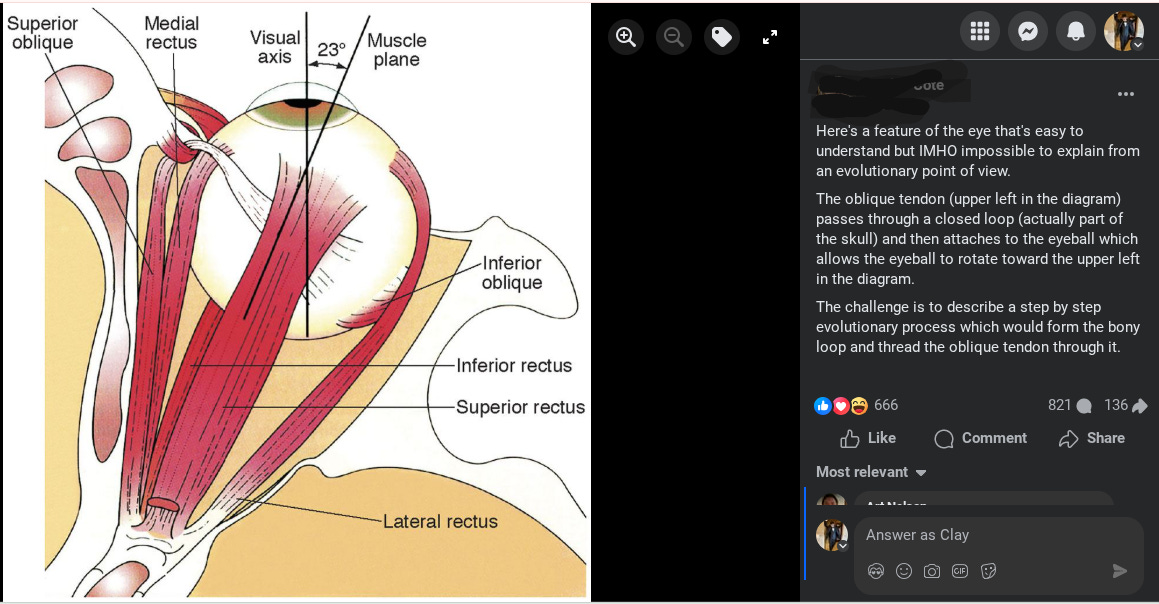
The problem isn’t only evidence. It’s language—and the moral heat we attach to language when our worldview feels threatened.
Research-Methods Note: Primary Source Link
Instead of selectively quoting cropped screenshots or paraphrasing a thread through my own bias, I’m linking the original exchange so you can read it in full context and describe what you see. That’s a better habit—especially for any topic that becomes identity-charged.
Primary source thread:
https://www.facebook.com/share/p/1CiecuUMUX/
If you read it, notice two things:
How fast the exchange shifts from mechanism to posture.
How quickly certainty rises while explanation drops.
Why This Moment Became a Preface
I’ve come to believe that our fiercest arguments are rarely about the thing on the screen. They’re about what the thing on the screen threatens to mean.
For some, the language of evolution sounds like teleology smuggled in—as if “nature” is a conscious engineer that must “know” the goal. For others, a design inference sounds like an attempt to baptize a gap with certainty.
So we end up speaking different dialects of the same human problem:
How do we explain the world without turning it into a god?
How do we defend God without turning our certainty into a weapon?
That second question is where Reframing Christianity begins.
Because my burden is not merely the evolution/creation debate. My burden is the way Christians (my own people) often try to win arguments while losing the mission.
Paul’s “Unknown God” and the Lost Art of Evangelism in a Divided World
When Paul stood on Mars Hill in Athens, he did something that modern Christians routinely forget how to do.
He did not begin with contempt. He did not begin with a threat. He did not begin with “read a book.” He began with a bridge.
He noticed an altar “to an unknown god,” and he used it as a translator’s opening—an act of disciplined empathy without doctrinal surrender. He entered their world, named what they were already reaching for, and then reframed it toward the living God.
That is not compromise. That is mission maturity.
In a world fractured by ideology, we are going to need Acts 17 Christians again: people who can walk into contested space, speak clearly, and still keep the human in the room.
This is not optional anymore. It is a survival skill for Christian witness.
Jesus, the “Riffraff,” and the Political Use of Religious Power
Jesus modeled this same posture in an even more offensive way: He went where the pain was. He ate with the people everyone else used as moral warnings.
And the Scribes and Pharisees condemned Him for it.
They wielded legalism not as a manifestation of God’s will, but as a power instrument—a way to control access, control status, control belonging. Their obsession was not holiness; it was authority.
And it should sober us, because the modern church can resemble that pattern far more than we want to admit.
If we can “tell someone off” in Jesus’ name more easily than we can sit with them, listen, and lead them toward truth with tears in our eyes—then we have not learned Christ. We have learned a religious technique.
That is Churchianity: Christian culture without the cruciform life.
Laodicea and the Moral Danger of Being Lukewarm
There is a description in Revelation that should haunt modern Western Christianity: the church of Laodicea—comfortable, self-assured, convinced it is rich and well, while being spiritually compromised and blind.
Whatever interpretive frame you bring to Revelation, the warning is unmistakable: lukewarmness is not harmless. It is offensive.
And here is the rub: we live in a religious marketplace where we can confuse sociocultural outrage with spiritual courage.
We can treat our online conflicts as if they are persecution.
We can parade around as if losing social status is the same as losing one’s life.
Meanwhile, many Christians globally worship under threat—quietly, carefully, often at real cost. We forget the weight of history. We forget the blood of the martyrs. We forget that the church has always advanced most powerfully when it could not advance politically—only spiritually.
And then we use the name of Christ to score points.
Woe unto us—the spoiled, the entitled, the lukewarm. Read what YHWH says about that posture. The warning is not subtle.
Why I’m Building Rockmore Rails© in Public Writing
I know my own vulnerabilities.
I have strong convictions, and I’m often incredulous when I hear “It all just happened.” I also carry real frustration with how Christianity has been caricatured—sometimes fairly, sometimes unfairly—because too many Christians have spoken with contempt while calling it courage.
So if I want to write something that actually reaches people, I need guardrails that force me into the middle-language—where truth can be examined without contempt, and where faith can be offered without manipulation.
That is what Rockmore Rails© are for: a disciplined translation layer that takes raw conviction and re-encodes it into language that non-tribal minds can hear.
Not softer. Clearer.
The Translation Charter (My Rules Going Forward)
These are the rules I’m using to lower heat and raise signal—whether we’re debating biology, politics, theology, or pain.
No touchdown tone without touchdown detail.
If you’re certain, show your work. If you won’t show your work, label your confidence as provisional.Mechanism first, meaning second.
If you claim “evolution did it,” describe the mechanism without metaphor.
If you claim “design did it,” describe what that claim predicts beyond “I don’t see how else.”Ban the contempt substitute.
“Read a book” is not an argument.
“Impossible” is not an argument.
Both are often identity moves.Translate agency language immediately.
If someone says “nature chose,” require the rewrite:
“Which traits increased reproduction in what environment—and why?”Keep the human in the room.
Christians do not win by being correct and cruel. We win by being truthful and present.
The Pharisees hated Jesus for where He spent His time. That should sober the modern church.
Why This Matters Beyond Biology
Most of our modern conflict isn’t actually about data. It’s about identity threats.
That is why online discourse feels like a religious war even when people claim to be “just being scientific.” It’s why we weaponize certainty. It’s why we confuse heat with light.
It’s amygdala thinking—certainty as anesthesia.
The antidote is not “be nicer.” The antidote is disciplined translation: a structure that keeps the conversation in the middle where it can be heard—and keeps the soul humble enough to be corrected.
That is what I’m trying to build—one post, one argument, one translation at a time.
Faith Thread (Reframing Christianity): Optional, but Central to Why I Care
I cannot “prove” eternity the way I can prove that a car will hurt you if it hits you. There is a real world “out there” that pushes back.
But the ultimate question I’m pressing is not merely biological mechanics. It is worldview.
If Christianity is true—even as a thought experiment—then the wager is not academic. It is eternal. That reality should change how we speak:
with urgency, yes
but also with humility
and with a translator’s discipline
Because when the stakes feel ultimate, our brains default to amygdala certainty. We grab identity. We moralize. We escalate. We protect the tribe.
That is how we lose each other.
And it is why Reframing Christianity exists: not to produce louder Christians, but truer ones—Christians who can speak to a fractured world the way Paul did in Athens, the way Jesus did among the wounded, and the way the early church did when it had no cultural power to hide behind.
A Sunday Discipline
Going forward, I’m going to publish these Faith Thread pieces on Sundays—as a deliberate practice of slower thinking, prayer, and “natural meditation on the Lord.” I want the discipline to match the message.
Years ago, during my IMPACT Hour at Cornerstone Community in Show Low, my 10:00 a.m. forum became a kind of laboratory for applied Christianity—book studies connected to modern events from the headlines. It was focused, alive, and spiritually explosive.
I want that kind of disciplined ministry again—this time in written form, with accountability, structure, and a public archive.
If you’re here for the spiritual writings, that’s the channel I’m building.
Subscribe
— this is where Sunday Faith Thread readers will gather.
Execute
Key Takeaways
Punts happen on both sides: “Impossible” vs. “Settled—read a book.”
The real battle is often language + identity threat, not evidence alone.
Christians must relearn Acts 17 translation and Jesus’ posture—truth with presence, not power with contempt.
Laodicea is a warning to the comfortable church: do not confuse outrage with righteousness.
Resonant Memory
Truth travels farther when it is translated.
Touchdown tone requires touchdown detail.
A middle language keeps the human in the room.
Mission requires humility.
© 2025 Dr. Clay ‘Dr. Rockmore’ Stidham / ViZionary HoriZons, LLC. All rights reserved. ICI©, IntentionalAI©, Cognitive Age©, Power of the Project©, Rockmore Rails©, and related frameworks are original works in progress—please do not reuse or adapt them in programs or products without permission.
If we can “tell someone off” in Jesus’ name more easily than we can sit with them, listen, and lead them toward truth with tears in our eyes—then we have not learned Christ. We have learned a religious technique.......love this.