
The Chisel
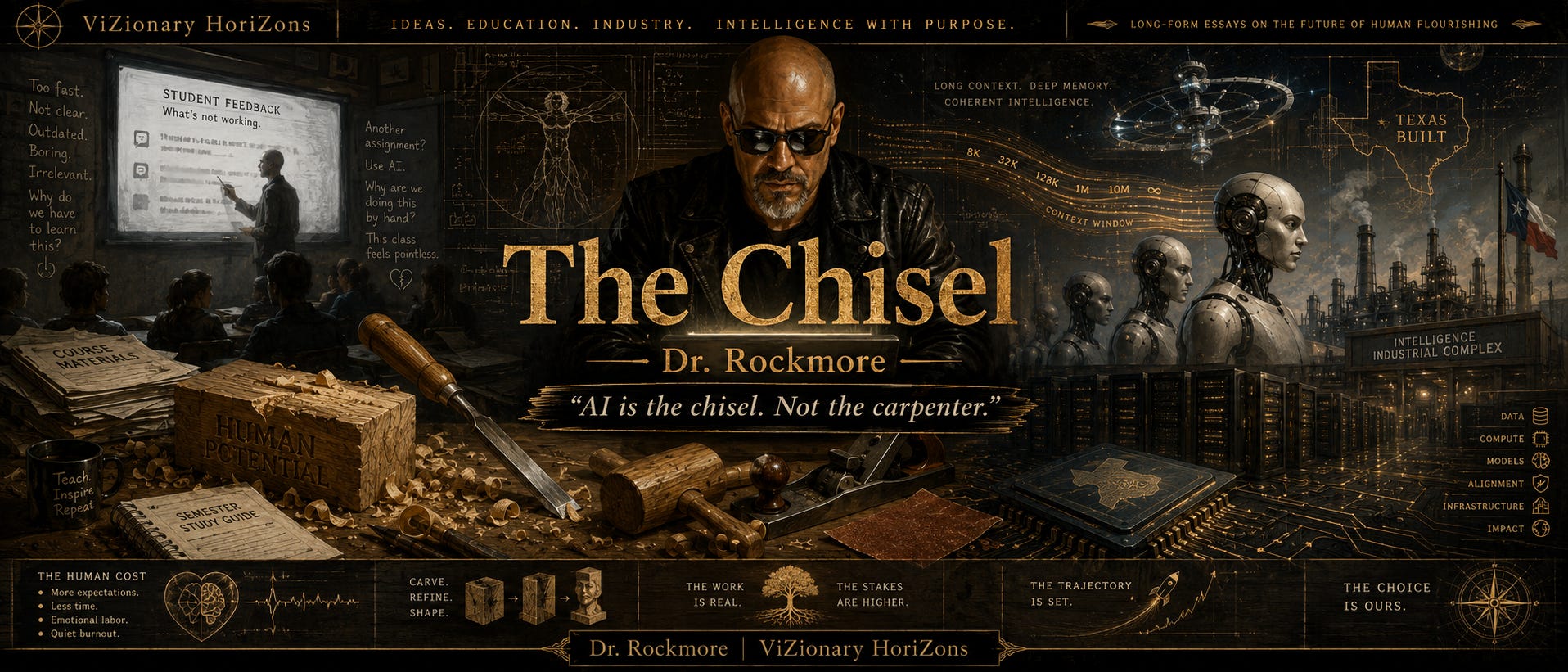
AI is the tool, not the carpenter.

May 16, 2026
Dr. Rockmore
The screen was too bright.
That is the first thing I remember. Not the words. Not even the rage that came after. Just the rectangular glow on the desk after AP season had already done what AP season does to a teacher’s nervous system. It was a feedback window, the kind students get after the machinery has finished chewing through the year. The test is over. The urgency is gone. You tell yourself you are ready for honesty.
Then you read the kind of response that does not feel like feedback.
It feels like a verdict.
Not the predictable adolescent complaint over workload or pacing. Teachers learn to absorb that. We know students do not always see the whole architecture. They see the task, the score, the stress, the class period that did not go the way they wanted. That is part of the job.
This was something else.
The kind of response that says, in effect, you did not earn the right to write that assignment, teach that course, push that hard, or ask that much of me. Not “I did not like your class.” The deeper accusation. You do not know how to teach. You do not understand us. You failed me, and the evidence is that I did not want to do what you asked me to do.
I sat there and felt it land in my body before I could make any intellectual sense of it.
The chest tightened. The heat rose behind the eyes. The old defensive machinery began its little courtroom. Pull the receipts. Remember the conferences. Remember the late nights. Remember the revised assignments and reteaching and scaffolds and study guides. Remember the students who said the opposite. Remember the kids who did grow, who walked into the exam with more language, more confidence, and more cognitive muscle than they had in August.
The brain goes hunting for evidence when the wound is close to the vocation.
That is the part outside the room people miss. Teaching is not a vending machine where students insert attention and teachers dispense points. At its best, teaching is a sustained act of belief. You walk into a room full of developing brains and decide, every day, that they are not finished yet. You decide the apathy is not the whole story. You decide the sarcasm is not the whole story. You decide the phone addiction is not the whole story. You decide the half-turned-in assignment, the eye roll, the blank stare, the missed deadline, the “I don’t know,” and the “I don’t care” are not the whole story.
You keep deciding.
And then one of the students you have spent the year trying to help looks back through that little glowing rectangle and tells you, in type, that the whole project was a fraud.
I did not read it with monk-like detachment. I will not pretend three decades in education has made me immune. Experience gives you categories. It does not give you skin made of kevlar.
Being criticized by students is not new. Every teacher who has done the work long enough knows the bargain. If you ask more than the room wants to give, somebody will decide the problem is you.
This one still cut.
It cut because the accusation reached the place where vocation lives. Not ego. Vocation. There is a difference. Ego says, “How dare they talk to me that way.” Vocation says, “Did I fail the work I was called to do?” Ego wants a comeback. Vocation wants a mirror.
That is why it hurt.
I stared at the words for longer than I should have, and the first answer that came was not a framework. It was a picture.
A 4×4 piece of wood on a workbench. Two people standing over it. Same chisel, same mallet, same plane, same sandpaper, same shop light, same block of raw material. One person sees a table leg. One sees a ruined afternoon. One sees grain direction, pressure, angle, resistance, and the little line where the wood is willing to open. The other sees a tool and assumes the tool should do the work.
That was the answer.
AI is the chisel.
Not the carpenter.
That sentence has been rolling around in my head ever since because it explains almost everything I am watching happen right now in classrooms, businesses, families, writing rooms, district offices, creative work, and the strange new cognitive economy we are all pretending we understand.
A chisel does not care what it makes. It does not wake up with artistic intention. It does not know whether it is shaping a chair, a doorframe, a pulpit, or a pile of splintered junk. It waits for a hand.
That hand matters.
The hand brings memory, pressure, judgment. The hand brings the small corrections that separate a gouge from a cut. It knows when to stop. It knows when the wood is resisting because the angle is wrong. It knows when the tool is dull. It knows that sometimes the right move is not more force but a different approach.
We keep arguing about the chisel as if the chisel explains the sculpture.
It does not.
A stronger chisel changes the work. A sharper chisel expands the possible. A pneumatic chisel alters the labor equation. A CNC machine changes the scale entirely. The tool matters. I am not minimizing the tool. I have built too much with AI to sit here and pretend it is a toy. AI has reach. It has speed. It can pull patterns across a body of text faster than any human I know. It can draft, compare, summarize, scaffold, simulate, translate, revise, pressure-test, and generate alternative pathways in seconds.
At one level, it is advanced autocorrect with reach.
At another level, it is the first everyday cognitive prosthetic many people have ever touched.
Both are true.
The quality of the work is still downstream of the person holding it.
That is why two people can use the same model, type into the same box, press the same little arrow, and walk away with radically different outcomes. One gets a dead paragraph dressed up in polite syntax. The other gets leverage. One gets the average of the internet in a clean shirt. The other gets an extension of an already-formed mind. One asks it to replace thinking. The other uses it to intensify thinking.
Same chisel.
Different carver.
I see this constantly. Someone opens an AI tool, asks for “a paragraph about stress,” copies whatever comes back, changes two words, and calls it finished. The work has no smell on it. No fingerprints. No friction. It is grammatically clean and cognitively empty. It has the little sheen of machine fluency that fools people who are tired, rushed, or not paying attention.
Then someone else opens the same tool and brings it a problem with edges. They give it context. They argue with it. They reject the first answer. They ask for a second frame. They force comparison. They bring personal memory, disciplinary knowledge, purpose, audience, constraints, and taste. They do not let the tool decide what counts as good. They use it the way a real craftsperson uses a shop full of tools.
That second person is not “cheating.”
That second person is carving.
The difference is not access. The difference is agency.
I have tried to build my whole public argument around that distinction without turning it into a slogan. IntentionalAI© is not a cute label for using ChatGPT on homework. ICI© is not a decorative acronym. Brain-Based Living is not a wellness phrase thrown over technology because it sounds calmer than the future actually feels. The whole point is cognitive agency under pressure. The human still has to know what job the tool is being hired to do. The human still has to define the shape of the work. The human still has to look at the output and decide whether it is useful, shallow, distorted, lazy, brilliant, dangerous, or almost right.
Almost right is where the carver lives.
A bad carver wants the tool to finish.
A real carver knows the tool only begins.
If you want more like this, subscribe — this is what I build here every week.
That is what I wanted some of my students to understand this year. Not because I wanted them dependent on AI. The opposite. I wanted them to stop being dependent in the old ways. Dependent on directions they barely read. Dependent on me re-explaining what was already written. Dependent on vague effort. Dependent on being rescued by partial credit, late work mercy, group momentum, inflated confidence, or the comforting lie that “I’m just not good at this” is a personality trait instead of a starting point.
AI exposed the dependency because AI removed the old excuses. The tool can explain the term. The tool can generate a first path. The tool can model an example. The tool can lower vocabulary, structure the concept, compare it to something familiar.
But only if the student is willing to use the tool to think.
That is the knife edge. Because the same tool can also let a student avoid thinking with more sophistication than any generation before them.
I know the difference because I have lived it from the other side.
During the research phase of a doctoral program, I had a stretch of about six months where the work stopped being a requirement and became a kind of compulsion. I was not trying to be dramatic. I was trying to answer the question in front of me, and the question kept widening. The more I read, the more I saw connections. The more I saw connections, the more the ordinary assignment shape started to feel too small for the actual argument.
There was a final test in that program. It could have been handled like a test. Answer the prompt. Meet the requirement. Stay inside the box. Move on.
I did not stay inside the box.
The response became a manuscript.
That sounds obnoxious if you have never felt a piece of work take over your attention. It was not about showing off. It was the opposite. It was the sensation that the wood had more inside it than the assignment was asking me to carve. I had the same tools available to everyone else. Word processor. Databases. Notes. Articles. Books. A blinking cursor. A deadline. A tired brain. A body running on too much caffeine and too little sleep.
Same chisel.
Different decision.
The tool did not make the manuscript. The hunger did. The pattern recognition did. The willingness to chase the thread did. The years of professional experience gave the research somewhere to land. The frustration with shallow answers gave the writing pressure. The accumulated reading gave me grain direction. The final product existed because I did not want merely to submit. I wanted to understand.
That is the part I wish I could pour into students. Not my specific research. The deeper thing. The moment when a task stops being a hoop and becomes material. The moment when you realize the assignment is not the point. The assignment is the wood. The question is what you can carve from it.
Most students have rarely been trained to think that way. Many adults have not either. We trained generations to complete. Then we handed them a tool that can complete faster than they can. Now we are shocked that completion has collapsed as a meaningful proxy for learning.
If the task is to produce a clean paragraph, AI can produce the clean paragraph. If the task is to make a slideshow that looks like school, AI can make the slideshow that looks like school. If the task is to sound like a competent ninth grader, a competent college student, or a competent mid-level analyst, AI can do it well enough to break most grading systems built on surface evidence.
So the task has to move.
Not because we are chasing novelty. Because the old evidence is no longer sufficient.
The real evidence is now judgment. Process. Revision. Explanation. Defense. Transfer. Human choice. The student has to show what they did before the tool, what changed after the tool, what they accepted, what they rejected, what they revised, and what they can now do without the tool in the room.
That is where the split is becoming visible.
It is not a clean split between “good students” and “bad students.” I do not trust those categories. They are too crude. The real split runs through motivation, identity, fear, skill, confidence, anxiety, habits, home life, attention, boredom, maturity, and whatever private story a student is carrying into the room.
Some students are carving.
They are not always the loudest. Not always the traditional stars. Sometimes they are the quiet ones who realize the tool gives them a way in. They ask better questions after the first weak output. They notice when the AI is being too vague. They compare examples. They use it to rehearse. They use it to translate confusion into language. They use it to make invisible steps visible. They still get frustrated, but the frustration moves. It becomes workable.
Those students are dangerous in the best way. They begin to see intelligence not as a fixed trophy stored somewhere behind the forehead but as a workflow. They learn that asking better questions changes the quality of the answer. They start treating feedback as material instead of insult. They learn that the first draft is not a confession of stupidity. It is a starting block.
Some students refuse the tool entirely.
That refusal can come from integrity. A student who says, “I want to do this without AI because I need to prove I can do it myself,” is showing agency. That student may be carving with older tools, but the hand is still active. There is honor in that.
But there is another refusal that is not integrity. It is avoidance in a costume. That student will not use AI, will not ask for help, will not read directions carefully, will not revise, will not engage the model or the teacher or the text or the feedback, and then will point to the existence of the tool as the problem. The tool becomes one more object to resent. Not because it failed. Because it removed the fog.
The fog was useful.
Then there is the group that wants the tool to carve for them.
That group is the most fragile right now because AI feels, at first contact, like an escape hatch. Paste the prompt. Get the answer. Submit the artifact. Move on. No sweat. No embarrassment. No struggle. No staring at the blank page while the room gets loud and your brain gets louder.
I understand the temptation.
I also know what happens next.
The scaffold reveals the dependency. The moment the student has to explain the work, defend a choice, revise a paragraph, connect the output to a concept, apply the idea to a new case, or produce an independent proof of understanding, the machine fluency falls away. The student feels exposed. Exposure feels like threat. Threat becomes anger. Anger looks for a target.
Sometimes the target is the teacher.
That is where the feedback came from. Not from the whole class. Not from every student. Not from the ones who used the year well. Not from the ones who struggled honestly. Not from the ones who were skeptical but engaged. Not from the ones who still have a long way to go but kept showing up.
It came from the refuse-side of the split.
I need to hold that distinction because resentment is a sloppy editor. One harsh student response can distort the whole room if you let it. Pain generalizes. A teacher reads one ugly line and suddenly the brain wants to repaint every face with the same brush. That is not fair. It is not accurate. It is not the work.
The room was not one thing.
It never is.
There were students that same year who surprised me. Students who built stronger academic language than they had at the beginning. Students who learned how to slow down and read the question. Students who used AI appropriately, awkwardly at first, then with more control. Students who did not love the system but understood the purpose. Students who fought the work and then, somewhere late in the year, started to see what the fight was for.
That matters. It matters because the diagnosis is not “kids are lazy.” That is too easy, and easy diagnoses usually protect the adult from doing better thinking.
The diagnosis is that the middle is collapsing.
For a long time, school survived on the middle. Not mastery. Not refusal. The middle. Students who would do enough. Teachers who could infer enough. Assignments that produced enough evidence. Grades that signaled enough compliance. Parents who saw enough movement. Systems that confused enough completion with learning to keep the machine running.
AI is breaking that bargain. The carvers get more leverage. The avoiders get more cover until the proof arrives. The middle thins.
That is why this is not a technology issue first.
It is a formation issue.
What kind of person is holding the tool?
That question becomes more urgent when you stop looking only at the classroom and look at the industrial curve.
The first piece that caught me was Tesla’s Q1 2026 shareholder deck. Not the fan commentary. Not the hype cycle around humanoid robots. The company’s own investor materials. In the manufacturing section, Tesla says preparations for its first large-scale Optimus factory were set to begin shortly in Q2. The first-generation line, designed for one million robots a year, is slated to replace the Model S and Model X lines in Fremont. Tesla also says Gigafactory Texas is being prepared for the second-generation line, designed for long-term annual production capacity of 10 million robots.
That number is the kind of number the brain wants to reject because it sounds like theater.
Ten million humanoid robots per year.
Maybe the timeline slips. Maybe the execution breaks. Maybe the first versions disappoint. Maybe the market is not ready. Fine. Every serious technological transition includes overstatement, delay, correction, bottleneck, and then, sometimes suddenly, normalization.
The number still matters because it tells you where the capital imagination is pointing.
Tesla’s same Q1 materials list Cortex 1 at more than 100,000 H100-equivalent GPUs in production and Cortex 2 at more than 130,000 H100-equivalent GPUs in early ramp. The company says Cortex 2 is online and running training workloads. It also says that in April it completed the final chip design of its next-generation AI5 inference processor.
That is the real story.
Humanoid robots are moving from demo theater toward manufacturing architecture. AI chips are moving closer to the edge. Training infrastructure is being co-located with the physical systems it will improve. The old separation between software intelligence and physical labor is narrowing.
The chisel is being wired into the shop.
The same acceleration is happening inside language models. Subquadratic came out with SubQ, a model built around one loud claim: 12 million tokens of long-context reasoning. The company says the model is designed to reason across full repositories, long histories, and persistent agent state, with a fully sub-quadratic sparse-attention architecture. The company’s own site also says the technical report is still “coming soon,” which means the right posture is interest with receipts pending.
That caveat matters.
Claims need proof. Benchmarks need independent pressure. Marketing language is not peer review.
But even if the largest SubQ claims get cut down by half, the signal remains obvious. The industry is attacking context. It is attacking memory. It is attacking latency. It is attacking cost. The systems are not just getting smoother at producing paragraphs. They are getting better at holding more of the work at once.
That changes the human role. When a model can hold an entire codebase, a legal archive, a multi-year research trail, or a long-running project history inside a single working context, the value of the human shifts even more sharply toward taste, judgment, intention, ethics, strategy, and lived context. The person who can direct that capacity becomes more powerful. The person who cannot becomes more dependent on whatever default shape the system offers.
Then came the compute story.
Reuters reported on May 6 that Anthropic reached a deal to use the full computing power of SpaceX’s Colossus 1 facility in Memphis. The facility houses more than 220,000 Nvidia processors and gives Anthropic 300 megawatts of new capacity within a month. Reuters also reported that Anthropic is interested in working with SpaceX on space-based orbital data centers. xAI’s own announcement says Colossus 1 includes more than 220,000 NVIDIA GPUs and that Anthropic plans to use the additional compute to improve capacity for Claude Pro and Claude Max subscribers.
Data centers in space.
I am not using that phrase because it sounds cool. I am using it because it tells us what the bottleneck has become. The frontier is not just model quality. It is power. Land. Cooling. Chips. Latency. Capital. Physical infrastructure. Launch capacity. The digital world is becoming heavy.
That is the curve.
Not apocalypse.
Trajectory.
I do not need to scream that the robots are coming. I do not need to baptize every corporate press release as prophecy. That is panic wearing a headset.
But I also refuse to sit in a classroom, watch the cognitive ground move under our feet, and pretend the old categories still hold.
The chisel is changing.
At first, AI felt like a writing assistant. Then a tutor. Then a research assistant. Then a coding partner. Then an agentic workflow. Now the infrastructure conversation is shifting toward massive compute, long context, embodied robotics, specialized chips, persistent memory, tool use, and systems that can act between prompts.
The chisel is starting to carve.
That sentence sounds like science fiction until it does not. The first time a student watches a model produce a passable essay, the chisel twitches. The first time a developer lets an agent refactor a codebase overnight, the chisel twitches. The first time a robot learns a physical routine from massive simulation and fleet data, the chisel twitches. The first time a system holds millions of tokens and finds the one thread the human forgot, the chisel twitches.
We are not at the end of human relevance.
But the easy version of human relevance is dying.
That is what I mean when I say the window is closing.
Right now, the sentence “AI is the chisel, not the carpenter” is still true in the most practical sense. A skilled human can extract far better work from the tool than an unskilled human. A disciplined mind can use AI to extend attention, deepen revision, sharpen planning, build products, test arguments, and accelerate learning. A lazy mind can use the same tool to generate polished mush.
The difference is still visible.
The carver still matters.
But the tool is getting better at simulating the moves of the carver. It is getting better at planning, remembering, checking, revising, and acting. It is gaining reach into systems that used to require human intermediaries. It is moving from text box to workflow, from workflow to environment, from environment to machine body.
So if we are going to train carvers, now is the time. Not after every student has learned to outsource the first move. Not after schools have spent five years playing plagiarism whack-a-mole with tools that no longer behave like plagiarism tools. Not after the labor market has quietly sorted people into those who can direct cognitive machinery and those who are directed by it.
Now.
Brain-Based Living is not a slogan for me. It is the name for the discipline underneath all of this. Attention is biological. Stress is biological. Memory is biological. Agency is biological. Tool use changes the nervous system because tool use changes the loop between intention, action, feedback, and reward.
A student who learns to use AI as a thinking partner is not merely learning software. That student is practicing cognitive control. They are learning to pause before accepting the first answer. They are learning to notice vagueness. They are learning to compare. They are learning to ask whether the output matches the task. They are learning to detect hallucination, overconfidence, and empty fluency. They are learning to keep themselves in the loop.
Keep the human in the loop is not enough.
Keep the self in the loop.
The self that wants to quit when the page is blank. The self that wants to submit the first clean answer because clean feels like done. The self that gets embarrassed by confusion and turns embarrassment into indifference. The self that reads criticism as annihilation. The self that wants the tool to rescue them from the discomfort that actually builds the capacity.
I am not exempt from that.
The student feedback hit me because my own nervous system wanted relief. It wanted a quick story. It wanted to say, “They just didn’t get it.” It wanted to say, “This generation is impossible.” It wanted to say, “I gave them everything and they threw it back.”
Some of that may be emotionally understandable.
It is not sufficient.
The better question is harder.
What did the wound reveal?
It revealed that the work is hitting the right fault line. It revealed that some students experienced the demand for agency as accusation. It revealed that the scaffold was not neutral to them. It revealed that being asked to show thinking felt, to some, like being exposed. It revealed that AI literacy cannot be separated from emotional regulation, identity, executive function, and the basic human terror of being seen before you feel competent.
That does not excuse cruelty.
It explains the room.
A generation has been handed the most powerful chisel ever made and told, by culture if not by name, that the wood should carve itself. Apps removed friction. Feeds removed boredom. Algorithms removed waiting. Search removed memory. Templates removed structure. Autocomplete removed the next few words. Recommendation engines removed the question, “What do I want?” Then AI arrived and threatened to remove the struggle that remained.
No wonder some of them are angry when we hand the struggle back. No wonder some of them look at a proof requirement, a reflection, a draft comparison, an oral defense, or a revision log and feel like the teacher moved the finish line. From their side, maybe we did. They thought the product was the point. We are telling them the process is now the evidence.
That is a brutal shift if nobody has trained your brain for it.
So I am trying not to gloat.
I am trying to grieve accurately.
The students who refused the tool are not my enemies. The students who wanted the tool to carve for them are not my enemies. Even the student whose feedback cut deeper than they probably understood is not my enemy.
They are signals.
Painful signals. Human signals. Signals from the front edge of a cognitive transition schools barely have language to describe.
My job is not to win an argument with a student comment typed after an exam. My job is to keep building the architecture that helps students become the kind of people who can hold the chisel without disappearing behind it.
That means insisting on proof when proof feels annoying. It means teaching AI boundaries without hysteria. It means allowing the tool where the tool strengthens thought and withholding it where the brain needs to bear weight. It means asking students to name their choices. It means making revision visible. It means refusing the lie that a polished paragraph equals understanding. It means giving the quiet carvers more room. It means not letting the loudest refusal define the whole room.
It also means telling the truth about the closing window.
The future will not reward people merely for having access to AI. Access will be common. The reward will go to those who know what to do with access. The carvers. The ones with enough self-command to slow down. The ones with enough taste to reject easy output. The ones with enough background knowledge to notice when the machine is bluffing. The ones with enough courage to bring their own question to the bench.
The wood is here.
The chisel is here.
The shop is getting louder.
And the hand still matters.
For now, it matters more than anything.
The serious question is who chooses to train it before the tool no longer waits so patiently for permission.
If you’re new here, subscribe so you don’t lose this thread.
Canonical link: https://drrockmore.substack.com/p/welcome-to-dr-rockmores-vizionary
Tags:
ViZionary HoriZons / ICI / IntentionalAI / Brain-Based Living / AI Literacy / AP Psychology / Education / Cognitive Agency / Cognitive Offloading / Humanoid Robotics / Optimus / AGI Trajectory / Generation Z
Drafted with AI assistance; final voice, claims, and edits by Dr. Rockmore.
© 2026 Dr. Clay “Dr. Rockmore” Stidham / ViZionary HoriZons, LLC. All rights reserved. ICI©, IntentionalAI©, Brain-Based Living, and all related original frameworks are protected intellectual property. Unauthorized use, reproduction, or adaptation is prohibited.
Another explosive analysis that lays bare the structure of man vs. machine. The unseen becomes visible in this commentary. The power of human emotion and biology vs the unrelenting mechanistic challenges of AI. Unless educators embrace painful reality with a mind and heart to wrestle with new challenges, the students in the system will emerge very underserved. In a very real sense, the teacher must require of himself even more than he requires from students. That is very painful. And yes. I used himself in the universal sense of mankind. Enough puffery. Machines are cold to gender. We are all human regardless of gender. It’s time to deal with the real. Our sensibilities must adjust to cold reality and refuse to submit to apocalyptic fatalism. This generation deserves our best and I am convinced that those who rise to the challenge will also reap the rewards. If anything, AI intensifies that equation.