
Why First Things Matter Most
The Origins Wall

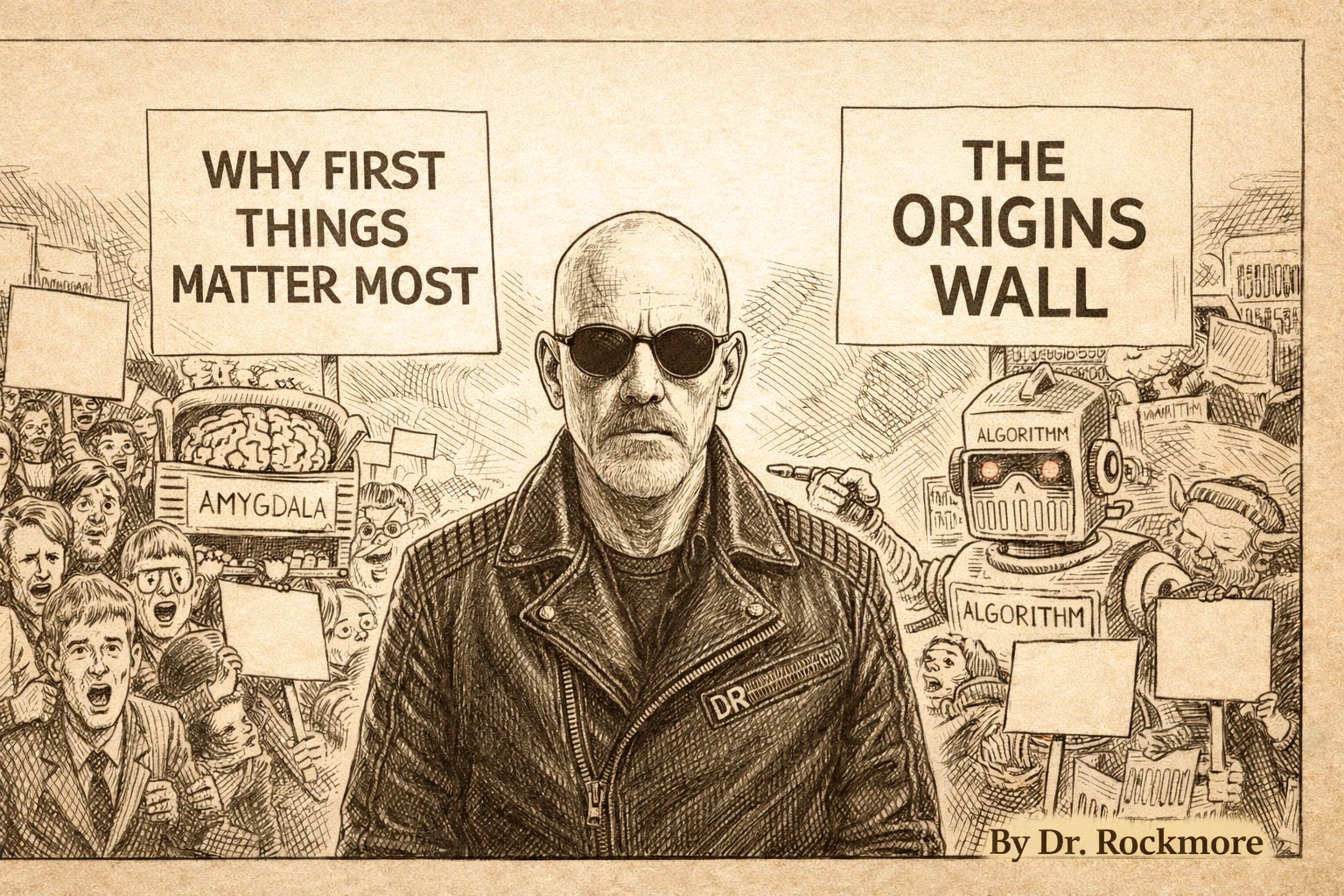
Friday after Christmas, I had a strange moment in my head. Quiet, brief, and unfamiliar. Not panic. Not pressure. Just a small logjam where no new ideas were stepping forward.
I was already in the pool when I noticed it. That matters, because the pool has become one of the clearest places in my life where first things get sorted.
The day before Christmas, I set a personal record: 2 hours and 57 minutes in the water, 5,000 meters. No drama, no speed, just relentless. This morning I went 3,500 meters, with extra time because I’m on vacation and I can invest in fitness without the usual time-tax. There’s something about that kind of steady work that makes the mind tell the truth.
If you want more like this, subscribe—this is what I build here every week.
That’s not a humblebrag. It’s a confession about how my mind works.
When my body does something steady and honest, my brain stops pretending. The noise settles. The electrical weather clears. I can feel the difference between “I’m being pulled” and “I’m choosing.” And I’m learning, really learning, that you can train your neurons the way you train your lungs: with repetition, intention, and a direction you refuse to abandon.
That’s why the logjam was interesting instead of scary.
Most of my life, a blank space in my head would trigger a reflex: fill it, fix it, rush it, prove something. But lately it’s different. It’s like the alarm system isn’t in charge. I can notice the moment, let it sit there, and then do the simplest, most important thing a person can do when life gets noisy: go back to first things.
My brain is always moving. Always firing. Little charges—thoughts, memories, impulses, reflexes—each one trying to recruit my attention. If I don’t aim those charges, they aim themselves. They drift toward what’s loudest, easiest, most rewarding in the moment. That’s not a moral failure; it’s a human default.
So the question becomes practical.
What am I doing with the electricity?
Because if the electricity isn’t aimed, it doesn’t disappear. It just gets spent on worry, distraction, drift, and a thousand tiny choices that slowly become a life.
That’s why first things matter so much to me. Not as a motivational poster. As a survival-level truth about how humans stay grounded.
I can almost picture “no end.” The line just keeps going: tomorrow, next year, another decade, another generation. It’s hard to hold, but it’s imaginable—a horizon that keeps retreating.
But when I try to look the other direction, when I try to conceive infinite rewind, my mind hits a wall.
I can’t build a life on a story that never actually starts.
I need a beginning. Ground. Something legible enough to bear weight.
That’s the Origins Wall. The point where the mind stops playing games and starts asking for foundation.
And this is where my Reframing Christianity thread actually begins. Not with a fight. Not with a hot take. With a method and a motivation.
This post is a bridge. If you’re here for the broader Dr. Rockmore thread—human behavior, attention, ethics, and the future—we’re staying in that lane. But if you’ve ever felt the deeper question underneath all of it—what story is actually true—I’m also building a Sunday series called Reframing Christianity. Same tone, same commitment to honest testing, just more explicit about the biblical foundation. This week, I’m going to start where foundations actually start: Genesis.
Part of that motivation is straightforward: Scripture doesn’t treat truth like a private hobby. It tells believers to be ready with an answer, to defend the hope within them, and it repeatedly invites testing rather than performative certainty. I take that seriously. Not because I’m trying to win arguments, but because everyone eventually has to decide what story they’re living inside.
Origins ground a worldview.
What you believe about the beginning changes what you believe about everything else: meaning, morality, identity, purpose, accountability, and what a human being even is. If the story has no beginning, it’s hard to justify why anything has ultimate meaning beyond preference. If the story does have a beginning, reality isn’t random. It has structure. It has intention. It has a direction that isn’t dependent on my mood.
And that matters because the mind is not neutral. It’s powerful, but it’s not neutral. It drifts toward fear of the unknown, fear of not being able to do what’s required, fear of social judgment, fear of where I stand in the pecking order. Those pressures are learned early, wired deep, and they run so quietly you don’t notice them until they own the room.
One of the strange gifts of teaching psychology is watching how universal this is. Different cultures, different families, different languages—yet the same stages, the same pressures, the same emotional physics. Humanity rhymes.
So I’m trying to build a biasless-seeking posture. Never perfectly biasless—none of us are—but at least biasless-adjacent. Honest enough to test assumptions. Curious enough to follow evidence without contempt.
Later on, that posture will matter when we start talking about history: dates, sources, distance from events, and why people accept one standard of reasoning for most of the ancient world and then shift the standard when Jesus enters the room.
We accept enormous witness gaps in one lane, then demand immediate documentation in the other. That isn’t always malicious. Sometimes it’s just fear—the uncomfortable possibility that if Jesus is real, He isn’t only a figure you can admire. He’s a Lord who gets to tell the truth about us.
But I’m not leading with exhibits.
I’m leading with the human reason the exhibits matter.
Because if I’m going to build a life inside a story, it can’t be a story I inherited without testing. It has to be a story I’ve walked around, pushed on, questioned, and found solid.
Which brings me to the modern pressure that makes this whole conversation impossible to avoid: AI.
AI isn’t coming. It’s here. It’s part of life now. And if we don’t get ahead of it with an ethical framework, we’re going to keep having the same small argument while the world changes underneath us: “Is it cheating?”
That question is already too small.
The bigger question is this: how do we form a human being who can use powerful tools without being used by them?
We’re not trying to end school. But it’s obvious where things can drift if we’re asleep at the wheel. Students can create at a level that used to require teams. They can build businesses from bedrooms. It’s going to be a wild age of creativity.
That’s exhilarating.
It’s also dangerous, because the same systems that accelerate learning can accelerate avoidance. They can become a machine people live inside instead of a tool they use.
That’s why the ethical lasso matters: agency, integrity, attention-respecting design, purpose. People like Tristan Harris have been warning for years what happens when we don’t build those constraints into the next era. I’m convinced that warning needs to become part of formation, not just commentary.
Because AI can hold a library. It can’t hold a purpose.
Purpose has to come from a person.
And that loops right back to first things again. If we don’t know what story we’re living inside, if we don’t know where we came from and what we’re for, we won’t have the internal architecture to use powerful tools wisely. We’ll drift. We’ll outsource thinking. We’ll confuse output with ownership. We’ll trade formation for convenience.
So here’s the Sunday commitment, plain and steady.
I’m going to build a thread that can hold weight.
I’m going to trace first things: origins, foundations, witness, meaning. Not because everyone has to agree with me, but because I’m not willing to live the rest of my life inside a story I’ve never tested.
And when I hit that wall again, and I will, I’m not going to numb it. I’m not going to scroll past it. I’m going to face it with sobriety, humility, and courage.
Then I’m going to aim the electricity where it belongs.
Drafted with AI assistance; final voice, claims, and edits by Dr. Rockmore.
© 2025 Dr. Clay ‘Dr. Rockmore’ Stidham / ViZionary HoriZons, LLC. All rights reserved. ICI©, IntentionalAI© (IAI), Cognitive Age©, Power of the Project©, and related frameworks are original works in progress—please do not reuse or adapt them in programs or products without permission.
If you’re new here, subscribe so you don’t lose this thread.
This is very well-written, Clay. Origin stories and foundations that don’t fold under pressure are the first things.
And, I think, they are the things most of us are most unsure, and therefore afraid, of.
I hear your request for openness, and not blind belief or follower-ship. You and I have debated some of the more closely tied biblical timeline constructs (our parents having come from two different places in Christianity, with equal passion and righteousness) and on some things we did not align, and that’s okay.
I am struck by the philosophical connections you are exploring between the first things, Genesis, and the structure and framework that form the story line of each of our lives.
I am deeply appreciative of science, and I too am deeply faithful. Our unique expressions of our faith are not vastly different - and I think we are all more alike than not.